Case study:
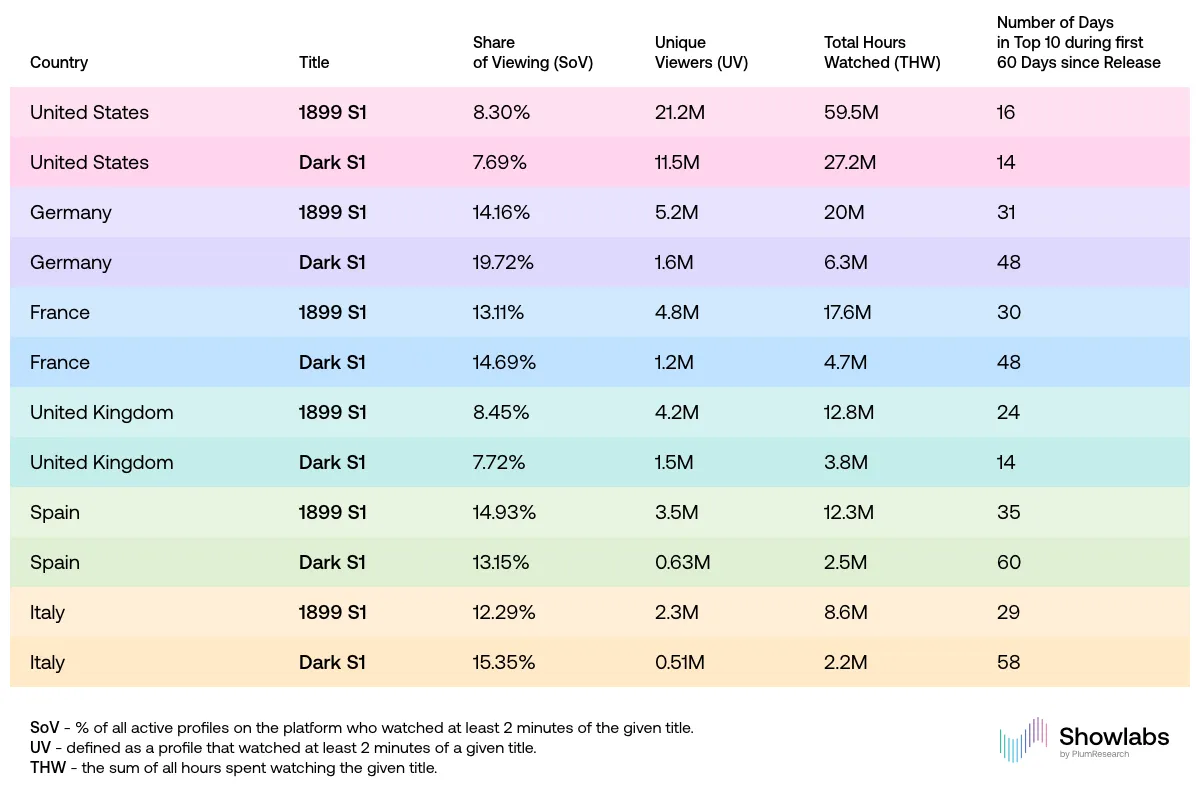
Viewership of 1899 in the USA
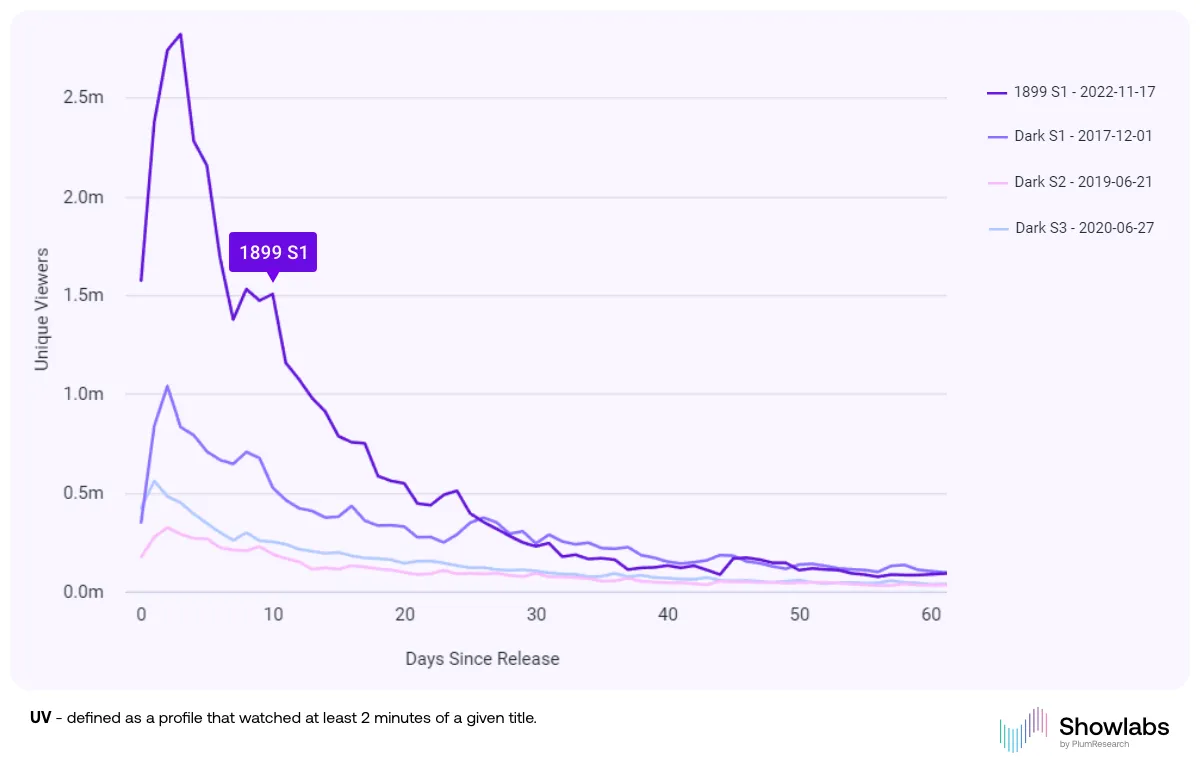
Let’s now focus on the United States and look at our standard Showlabs metrics. We compared both series' Unique Viewers (UVs) since the release date to discover that “1899” had a much stronger start on Netflix. From the first day of its availability, the series captured around 1.6M Unique Viewers (UVs), with a peak of more than 2.8M UVs on day 5! None of the three seasons of “Dark” beat that number.
Figure 2. 1899 and Dark — Unique Viewers (UV) Since Release Date, United States
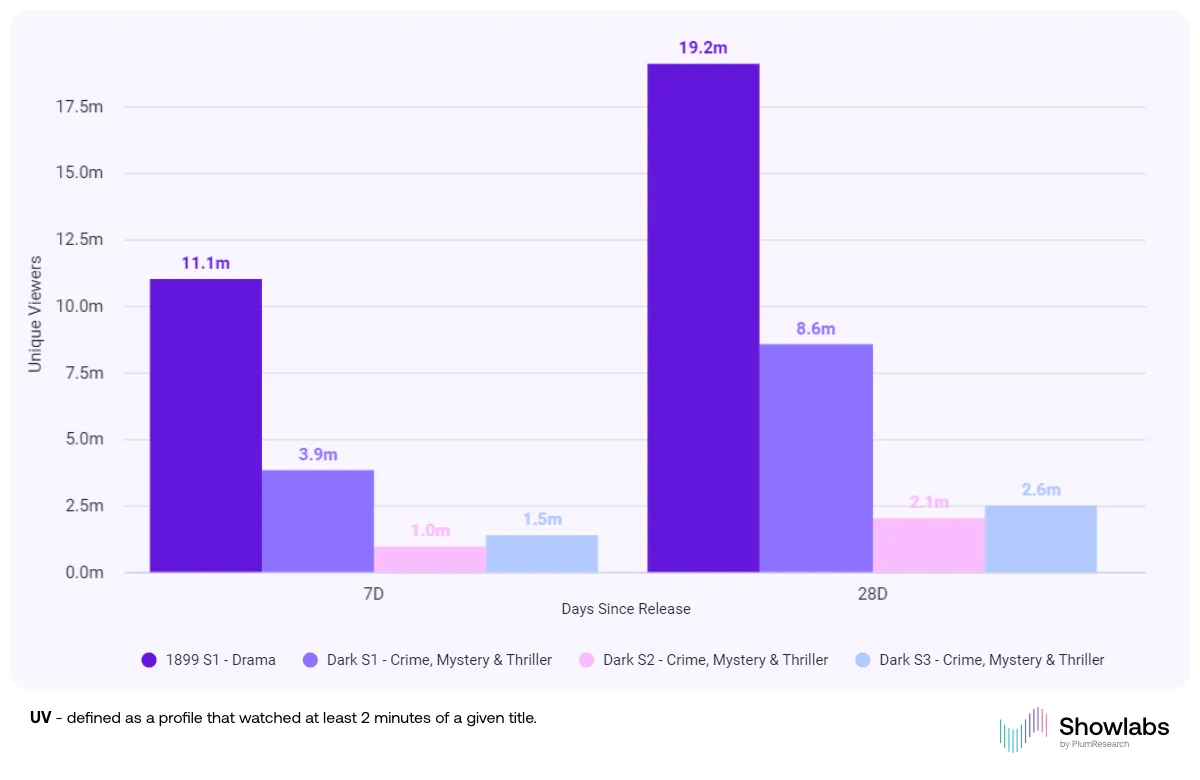
We dug deeper by comparing Unique Viewers (UVs) after 7 and 28 days on Netflix.
Figure 3. 1899 and Dark — 7-, and 28-Day Unique Viewers (UVs), United States
Is the low Completion Rate one of the reasons behind the 1899 cancelation?
By Completion Rate (CR), we mean a percentage of Unique Viewers (UVs) who fully watched all of the episodes of a single season to all Unique Viewers (UVs) who fully watched the first episode in the season.
Figure 4. 1899 and Dark — 7 and 28 days Completion Rate (%), United States
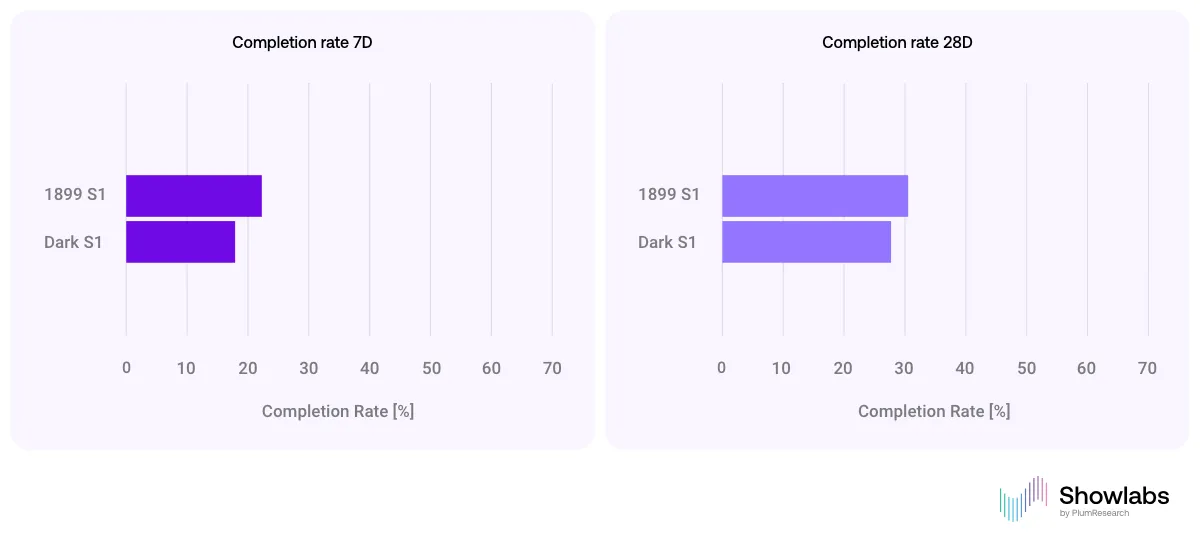
1899 had a higher Completion Rate (CR) than the first season of Dark!
- After 7 days, it was 22% for “1899” and 18% for “Dark” S1.
- After 28 days, the gap was around 3% in favor of “1899” (CR 31%).
Well, evidently, the Completion Rate speaks in favor of “1899”. Nevertheless, CR at the level of 30% is not as impressive a result as it could be. Let's look at other scripted series debuting on Netflix around the same time as "1899.”
Figure 5. Inside Man, Manifest and Wednesday — 7 and 28 days Completion Rate (%), United States
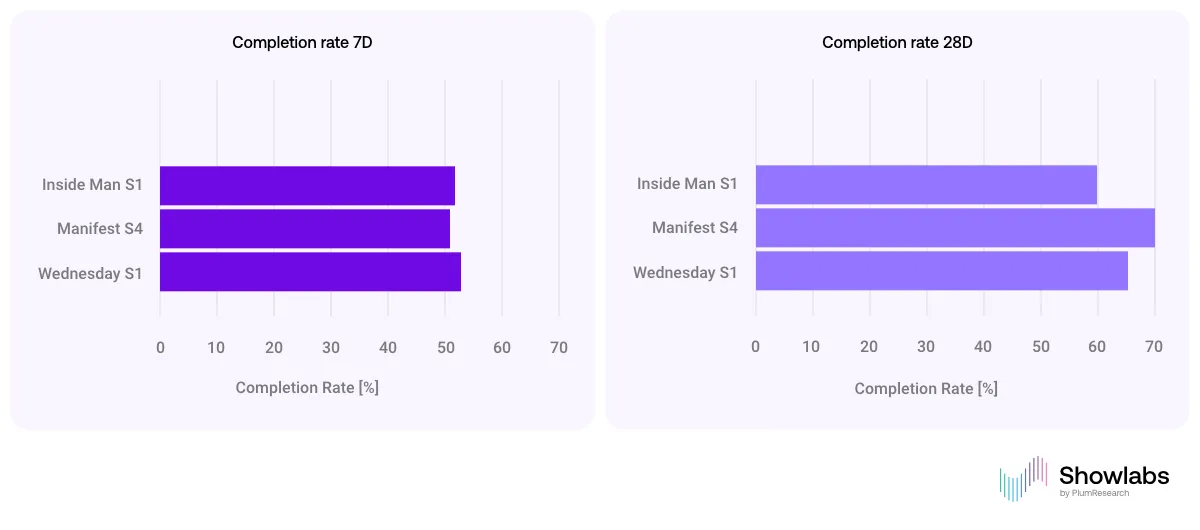
The Completion Rates of 1899 and Dark are close. Still, both fall short compared to the CR of Inside Man S1, Manifest S4, and Wednesday, where all three exceeded the 50% benchmark. Comparing the CR metrics, we can assume that the low completion rate might have impacted the 1899's cancellation.
The Get Hooked metric helps us determine how “addictive” the show was! The answer to the question “Why 1899 was canceled” may also be hidden here.
We used our Get Hooked (GH) metric to determine the earliest possible episode where at least 70% of the episode viewers finished the whole season.
Figure 6. 1899 and Dark — Get Hooked (GH) metric, the United States
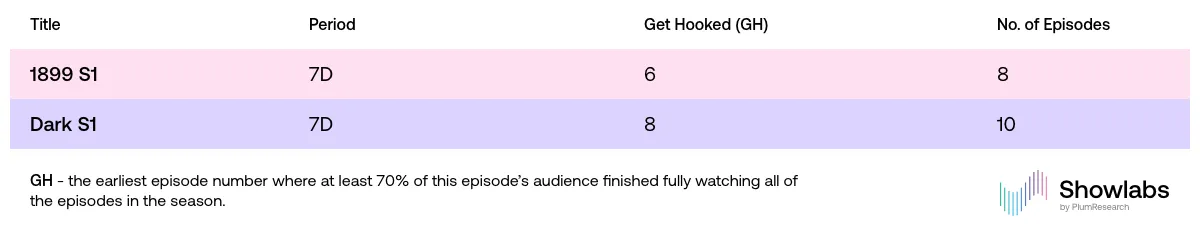
The US audience found 1899 more addictive than Dark. While Dark took eight episodes to complete the season within a week of its release, 1899 only took six. However, considering their respective lengths, both series reached their "point of no return" two episodes before the finale. We may conclude that, in our case, the GH results were comparable, but only among their quite specific audiences.
But how "addictive" was the competition?
To put both titles in context, we also checked the Get Hooked metric of Inside Man S1, Manifest S4, and Wednesday.
Figure 7. Inside Man, Manifest and Wednesday — Get Hooked (GH) metric, the United States
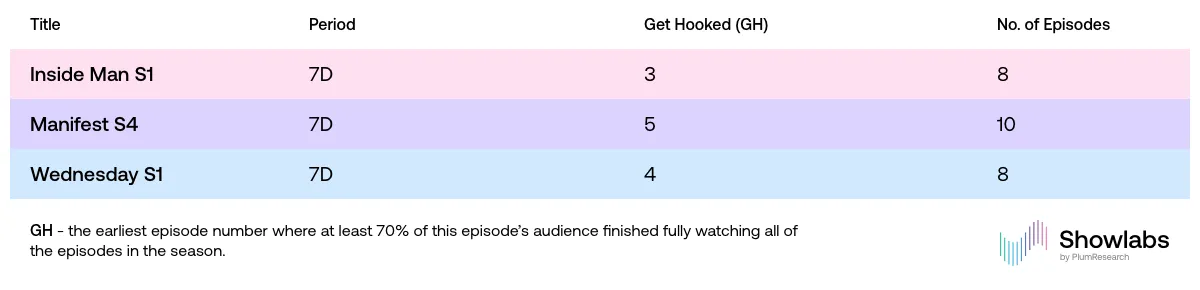
Our data shows that viewers who watched 1899 were more likely to be drawn into other titles available on Netflix at the same time. For example, the viewers following the adventures of young Wednesday Addams needed to watch at least four of eight episodes to stay until the show's finale. Inside Man, the thriller series starring Stanley Tucci and David Tennant, had an even better result; most viewers got addicted after the third episode.
For further information, we recommend referring to the full article. It offers a more comprehensive understanding of the topic and can provide valuable insights.
Returning to our central question:
Why did Netflix sink 1899 right after the first season, although the show's performance was strong when analyzing the viewership data?
There may be a few possible reasons:
Despite the general good audience results, 1899 was popular in a very specific viewer community. It is safer for producers and distributors to put their bets on the content, attracting more diverse viewers
Good basic metrics, like Total Views and Total Hours Watched, are not enough in the fragmented and saturated SVOD landscape today
Getting the audience hooked faster and stronger is challenging for content producers and distributors—precise data on more advanced audience habits is necessary here
Other Netflix content released around the 1899 premiere performed better in the same period. Streaming platforms, Netflix included, need to be very selective in deciding where to put their future investment focus, especially when dealing with big-budget productions like 1899 that require significant financial resources